The Short Answer
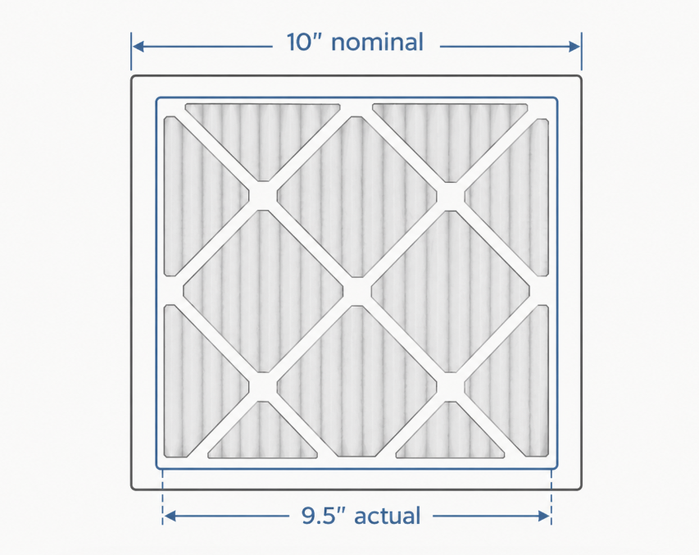
A 10x10 return grille takes a 10x10x1 air filter, and that filter measures about 9.5" x 9.5" x 0.75" on a tape. Nothing is wrong with it. The printed number is the nominal size, rounded up so the frame slides into the track instead of jamming.
I learned this through an embarrassing mistake. My first month covering turnovers, I measured 9.5 inches and wrote a ticket claiming the last tenant bought the wrong size. My supervisor opened four more units. Every filter measured the same.
Key Takeaways
• A 10x10x1 filter typically measures about 9.5 x 9.5 x 0.75 inches.
• Measure the inside filter track, not the grille face.
• Order using the nominal size printed on the filter frame.
• The filter should fit flat and snug without being forced to help prevent air bypass.
Nominal vs. Actual Air Filter Size
Nominal size is the label you order by and describes the opening. Actual size is what the frame measures, roughly a half inch smaller. A filter cut to a true 10 inches would bind, bow when forced, and leave a wavy edge for air to slip past.
Here is the part almost nobody tells you: that clearance is not standardized. Each manufacturer picks its own tolerance. Filterbuy trims a half inch and lands at 9.5. Filtrete trims less and lands near 9.81. Both are sold as 10x10x1 and both are correct. Filterbuy publishes its actual size on the 10x10x1 listing instead of burying it in a spec sheet.
I found this out when a property switched suppliers mid-year. Filters that had dropped into the same tracks for eight months suddenly needed a firm push, and two bowed enough to show daylight at the corner. Only the brand had changed. Filterbuy's air filter sizes chart lists actuals side by side.
Which tolerance is better? Neither. A 9.5-inch frame leaves a quarter inch of gap per side: easy to install, marginally more room for air to sneak past. A 9.81-inch frame seals tighter but catches on tracks with a bent lip or paint buildup. What matters is that it goes in without force and sits flat.
The rule I give tenants: order by nominal size, but read the actual size on the frame before buying in bulk. The same rounding governs every apartment filter size. A 20x20x1 lands near 19.5, and the "1-inch" depth is really 0.75 on nearly every pleated filter made.
How to Measure a Return Grille for a Filter
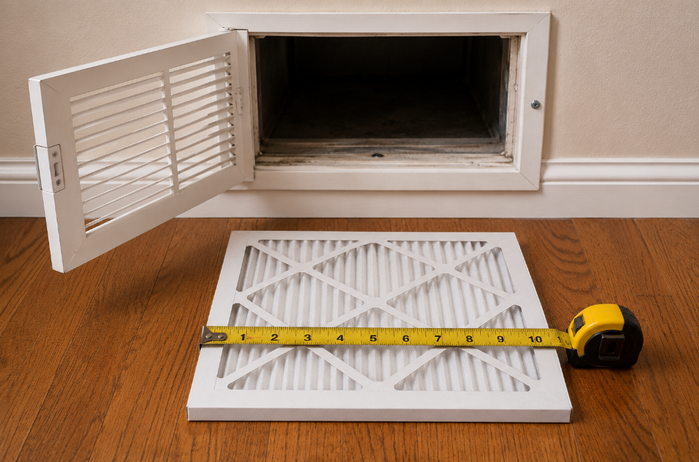
Measure the inside of the filter track, not the grille face, then round up to the nearest inch. A 9.5-inch track means you order 10x10x1. Two minutes, once, and you never second-guess an order.
1. Open the grille, hand underneath. Ceiling and wall returns use thumbscrews or a spring hinge. On ceiling returns the filter sits loose and drops the moment the door swings.
2. Read the frame. Nominal size is in large type on the edge, actual often in smaller print below. Legible? Order that nominal size.
3. Frame blank? Measure the track for width, height, and depth.
4. Round up. Depth near 3/4 inch means a 1-inch filter.
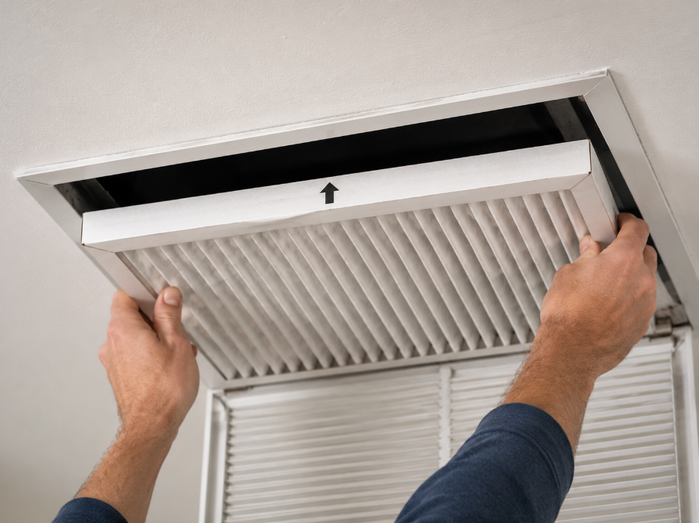
5. Check the airflow arrow. It points toward the ductwork: up into the ceiling, or into the wall. See which way a filter goes in an AC return.
The mistake I see most: measuring the trim instead of the track. On several units the visible frame measured close to 12 inches while the track behind it was a straight 10x10. The tenant orders a 12x12, it will not seat, and concludes the industry is broken
"The half-inch gap is not a defect. It is the tolerance that makes the filter installable. What actually causes bypass is a filter forced into the wrong track. Bent frame, bowed pleats, daylight at the corner. In eight years I have never seen a correctly sized filter leak because it was a half inch small. I have seen plenty leak because someone crammed one in."
EPA's Guide to Air Cleaners in the Home says to pick a filter that seats snugly without air leaking around it, and warns against bending or crushing one to fit. DOE gives the consequence: obstruct airflow and air bypasses the filter, depositing dirt onto the evaporator coil.
Still Will Not Go In? Diagnose It in 30 Seconds
Nine times out of ten the cause is one of the first three below, and none mean you ordered the wrong size.
1. Filter cocked in the track. A 10x10 cannot go in backwards, but it can go in crooked. Back it out, square it up. Try again with no pressure.
2. An old filter still in there. Twice I have found two stacked in one track, the bottom flattened against the housing.
3. Track painted over. Repainted returns lose width at the lip. A putty knife along the edge recovers the eighth of an inch you need.
4. Grille door not fully open. Some hinged doors must swing vertical before the filter clears.
5. Wrong depth. A 1-inch filter in a 2-inch track goes in easily, then shifts. Worth catching now.
6. Do not cut a larger filter down. Cutting severs the frame holding the pleats in tension and exposes raw media edge, producing the exact bypass path you were avoiding. A cut filter performs worse than a slightly loose correct one.
What a 10x10x1 Costs, and Why Quantity Matters
Small filters are not cheap filters, and here the quantity discount is unusually steep. A 10x10x1 has under a quarter the media area of a 20x20x1 but nowhere near a quarter the price, because frame and packaging and shipping barely scale with area.
From Filterbuy's 10x10x1 air filter listing at the time of writing:
1 filter: $22.99 each
3 filters: $9.66 each
6 or more: $5.83 each
That is a 75% drop between one and six. At a 90-day interval, four filters covers a year in one return. Buying one at a time on a size you cannot get locally is the most expensive way to do this, and it is the renter default.
When 10x10x1 Is Not the Right Filter
Track measures a true 10 inches or more. You may need an "actual size" 10x10x1 built at a full 10 x 10. Specialty item. Standard 10x10x1 filters will not fill it; Filterbuy's is 9.50 x 9.50 x 0.75.
Track deeper than an inch. A 2-inch or 4-inch track needs a 10x10x2 or 10x10x4. I have pulled 1-inch filters from 4-inch tracks that had shifted sideways and were filtering almost nothing. See using a different size air filter.
Opening is rectangular. Many returns are 10x20 or 12x12. Measure both directions.
More than one return. Measure each. I have worked units with a 10x10 in the hallway and a 14x20 in the living room, and tenants routinely order two of whichever they checked first.
Your lease assigns it to management. Many do, though tenants often own the return-duct filter. Check who replaces the air filter in an apartment. Buy them anyway? Keep receipts. I have seen tenants reimbursed at move-out.
Essential Resources for Choosing a 10x10x1 Air Filter
In the order you need them.
1. Confirm the Exact 10x10x1 Spec Before You Pay
10x10x1 Air Filters / Filterbuy. Actual 9.50 x 9.50 x 0.75-inch dimensions, MERV options, quantity pricing.
2. See Why the Same Nominal Size Measures Differently by Brand
Air Filter Sizes Chart / Filterbuy. Nominal versus actual for every common size, with a cross-brand comparison showing actuals do not match.
3. Pick MERV 8, 11, or 13 on Capture Data, Not Marketing Tiers
What Is a MERV Rating? / U.S. EPA. Capture efficiency by particle size, MERV 1 through 16, plus EPA's MERV 13 recommendation.
4. Know What a Correct Fit Looks Like
Guide to Air Cleaners in the Home / U.S. EPA. Seat it snugly with no air leaking around the edges, never bend or crush one, replace every 60 to 90 days.
5. Understand What a Bad Fit Costs
Maintaining Your Air Conditioner / U.S. Department of Energy. Obstructed airflow sends dirt onto the evaporator coil. A clean filter cuts AC energy use 5% to 15%.
6. Get an Independent Health Read, Plus a Dirt Test
Air Cleaning / American Lung Association. Neither government nor manufacturer. Confirms the 1-inch return-grille norm and MERV 8 default, plus a field test: hold it against white paper.
7. Find Out Whether You or Your Landlord Buys It
Why You Should Change the Air Filters in Your Apartment / ApartmentAirFilter.com. Landlords typically handle the blower filter, tenants the return-duct filter. Your lease decides.
Supporting Statistics
1. About 1 in 3 U.S. Households Rents
65.0% U.S. homeownership rate, Q2 2026, leaving roughly 35% renter-occupied.
Rentals put the filter behind a ceiling or wall return grille, not a furnace cabinet.
Return grilles are where small sizes like 10x10x1 live, and where the confusion starts.
What I see on the ground: almost every unit I service has its filter overhead in a hallway ceiling. That is why renters ask this and homeowners rarely do.
Source: U.S. Census Bureau, Quarterly Residential Vacancies and Homeownership, Q2 2026 (July 28, 2026).
2. Indoor Air Is Where the Exposure Happens
Americans spend about 90% of their time indoors.
Some indoor pollutant concentrations run 2 to 5 times higher than outdoors.
Levels climbed as energy-efficient construction outpaced mechanical ventilation.
A filter leaking around its edges fails in the exact space where you spend nine hours out of ten.
Source: U.S. EPA, Report on the Environment: Indoor Air Quality (updated May 27, 2026).
3. Your Filter Only Works While the System Runs
HVAC systems run under 25% of the time in heating and cooling seasons.
No runtime, no filtration. The window is narrow already, and bypass around a badly seated frame shrinks it further.
What I see on the ground: tenants running the fan on AUTO all winter get cleaner filters at 90 days than neighbors running it on ON. Same building, same filter, different runtime.
Source: U.S. EPA, Guide to Air Cleaners in the Home (updated February 17, 2026).
Next Step: Confirm, Then Order
Pull your filter, read the frame, and write both numbers, nominal and actual, somewhere you will find them. I write mine inside the cabinet door under the sink. Ten seconds, and the guessing ends.
Filterbuy makes the 10x10x1 air filter in MERV 8, 11, and 13 at an actual 9.50 x 9.50 x 0.75 inches, the spec a 10x10 return grille is built around.
Frequently Asked Questions
Does a 10x10x1 air filter fit a 10x10 grille?
Yes. The roughly 9.5 x 9.5 x 0.75-inch frame gives the clearance to slide into the track and sit flat.
Why is my new filter smaller than 10 inches?
10x10x1 is the nominal size, not the measured one. A true 10-inch filter would bind and bow. See does an air filter have to fit exactly?
Do all 10x10x1 filters measure 9.5 inches?
No, and this trips people up. Most land at 9.5, some brands run closer to 9.81. If your track is tight, note which brand fit and stay with it.
Is a 1-inch filter really 1 inch thick?
Almost never. Standard pleated 1-inch filters measure about 0.75 inches deep.
What if my filter is loose and rattles?
Slight play is normal. Persistent rattling usually means wrong depth or a door not latched flush. Do not tape it. I have found taped filters with the tape peeled back and hanging into the duct.
Can I cut a bigger filter down to fit?
No. Cutting destroys the frame tension holding the pleats open and exposes raw media edge, leaving more bypass than before.
How often should I change it?
EPA points to manufacturer guidance, typically every 60 to 90 days, shorter if heavily soiled. Go 30 to 60 days with pets or heavy cooking. In my experience 10x10 returns load faster than large ones, because the same airflow concentrates through less media. See how often to change an apartment air filter.
Is 10x10x1 hard to find?
In stores, usually. Filterbuy, which notes it has made over 10 million filters, classes 10x10x1 as an uncommon size big-box retailers do not reliably stock, and ships it direct in MERV 8, 11, and 13. I gave up on local runs years ago and order a year at a time.
Glossary
Actual size: The physical dimensions of an air filter when measured with a tape measure. A nominal 10x10x1 filter may actually measure about 9.50 x 9.50 x 0.75 inches.
Air bypass: Air that travels around the edges of a filter instead of passing through the filter media. Poor fit, bowed frames, or incorrectly installed filters can increase bypass.
Air filter: A replaceable HVAC component designed to capture airborne particles as air moves through a heating or cooling system.
Airflow arrow: The directional arrow printed on a filter frame. It should point toward the ductwork or air handler, following the direction the air travels through the HVAC system.
Evaporator coil: The indoor HVAC coil that absorbs heat from the air during cooling. Restricted airflow or dirt that bypasses the filter can contribute to buildup on the coil.
Filter media: The pleated or flat material inside the filter frame that captures dust and other airborne particles as air passes through it.
Learn more about HVAC Care from one of our HVAC solutions branches…
Filterbuy HVAC Solutions - Miami FL - Air Conditioning Service
1300 S Miami Ave Apt 4806 Miami FL 33130
(305) 306-5027
https://maps.app.goo.gl/Ci1vrL596LhvXKU79